
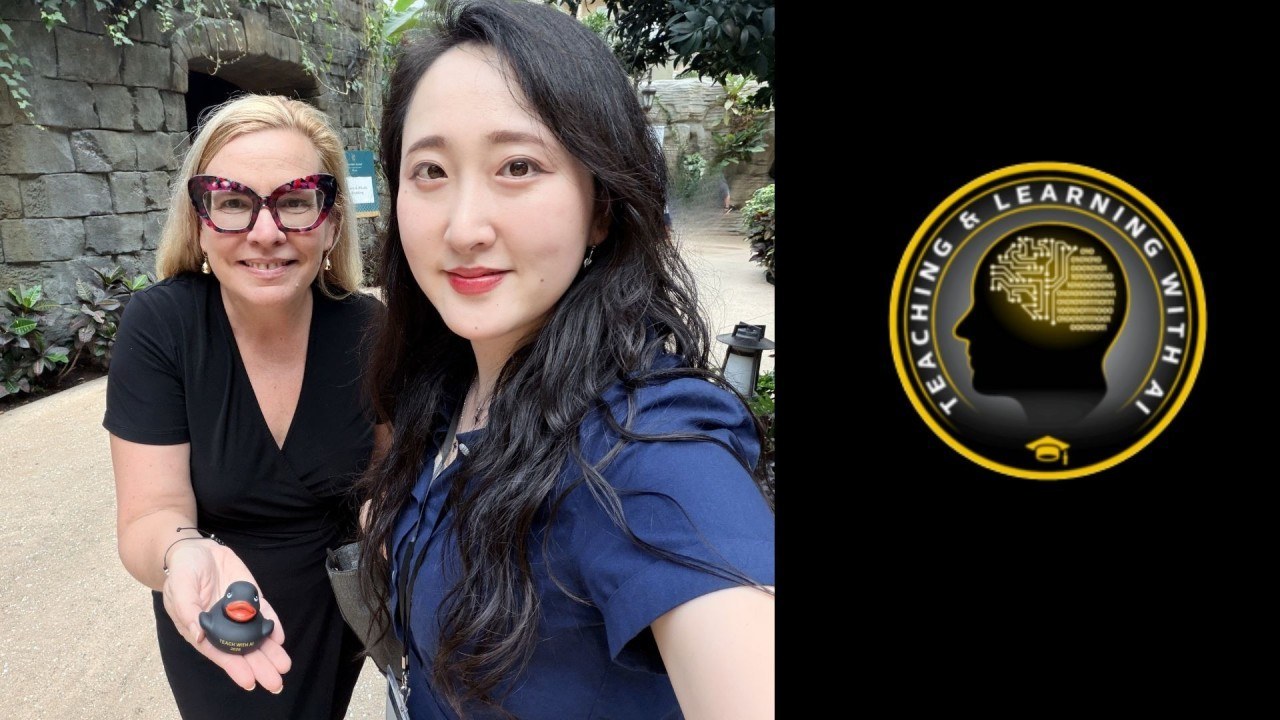
After I gave my talk, someone pressed a rubber duck into my hand. Not a metaphor. An actual rubber duck, black, with three words stamped on the side. Teach with AI.
Every presenter got one, and it came with an instruction. Do not keep it. Share it, find your people, pass it on.
So I did. I traded mine with Eunie Shin, another speaker at the conference.
We met in someone else's session. Two strangers in the audience started talking and could not stop. Eunie is a professor of management at Berry College, and she studies where ethics, AI, and creativity meet. We carried the conversation into lunch. What AI is changing in business education. Where the ethics get hard. Where creativity still belongs. We had fun with it, which is its own kind of connection. By the end of lunch, it felt like we had known each other for years.
So when I looked down at that little duck and its instruction, the choice was easy. Share it. Connect. Pass it on. We traded ducks. The more important trade was conversation and friendship.
That is the real lesson of the duck. We do not have to do AI alone. Find your people. The ones you can brainstorm with, share a half-formed idea with, build something beside. The work gets lighter. The ideas get sharper. That is the Power of We.
That little duck is the reason I am writing this. Here is the question every educator I know is asking right now. If a machine can write the essay and answer the prompt, what is left for us to do?
The Room That Doubled
I went to Orlando looking for an answer. I found it in a room that seemed to have doubled in size in a single year. Over a thousand educators, librarians, and instructional designers in one place.
I was in that room last year too. Standing in it again, all I can say is wow. We have come a long way together in finding our way with AI, faster than I would have guessed.
The 4th annual Teaching and Learning with AI Conference, hosted by UCF in Orlando, was interdisciplinary on purpose. Faculty from every field. Instructional designers. Librarians. Administrators. This year, K-12 teachers too. Thank you, Kevin Yee and team, for building this room again.
People flew in from Hawaii, Alaska, California, New York, Montana, and Texas. Some were deep in advanced AI workflows. Others were opening the door for the first time. None of them were waiting to find out what AI would do to their classrooms. They came to decide together.
Here is what I keep coming back to about innovation. It is not the newest tool or the fastest adopter. It is staying curious, asking the next good question out loud, and sharing what you find.
The best questions rarely come from inside your own field. They come from the edges, where a librarian, a marketing professor, and a high school teacher compare notes and land on something none of them would alone. Crossing disciplines is not a nice extra. It is the way forward. That is the Power of We, at the scale of over a thousand people.
What I Came to Share
I presented my new book, KEEP SHINING: Rediscovering Purpose and Connection in a Digital World.
Here is what it is about. We are more connected than ever and somehow more alone. I call that distance the Presence Gap, the space between who we are inside and how we actually show up. AI is widening it. The tools that promise to save us time can quietly pull us further from each other, and from ourselves. KEEP SHINING is not about rejecting technology. It is about staying fully human inside it, and closing the gap in three places. With yourself. With each other. With your purpose.
That is the question this whole room was already living. How do we stay human while everything speeds up?
This was the first time the finished book came with me to a conference. I have spoken on KEEP SHINING all year, but carrying the real thing into the room was new. It took two years to write, and because my life and travels shaped it as much as my research did, there is a vulnerability in seeing these personal stories sit right beside the evidence. I was nervous to put that much of myself into the world, but now that it is out, it feels right.
So I shared it. I gave copies to a few people I connected with, treating the book as more than just a text — it was a piece of my heart. Handing it over felt special in a way I did not expect, because it reminded me of the butterfly effect: the principle that our smallest actions carry profound weight. Just like a single flap of a wing can trigger a distant storm, a casual conversation in a hallway or the quiet act of sharing a book can set a chain reaction in motion. We are part of a complex, interconnected system where our individual ripples, the books we pass on, the ideas we trade, and the colleagues we lift up transform the entire ecosystem.
I hope the people I shared it with read it, then pass it on. One already has; she stayed up until midnight with it, which made me smile big. Another has a book club, and I am hoping it lands there, one copy becoming a circle of readers I will never meet. That is the point of the butterfly effect: a small thing that keeps moving. I may never know where it lands, but I trust that these gestures of connection ultimately shape the future of our classrooms and communities. The book names the things that keep us connected and purposeful, and that week in Orlando, I saw them everywhere: innovation and the power of new friends.
New Friends, and a Community of Practice
The thinkers at the front of this field were in the room too, and they were reachable. That is its own kind of innovation, when the people writing the books will stand in a hallway and trade ideas with you.
We opened the conference with the keynote speaker C. Edward Watson. Watson's own work makes this exact case. He champions faculty learning communities, educators gathering across disciplines to work through AI together, as the real answer to the disruption. The keynote and the rubber duck were saying the same thing. Do not do this alone. If you are looking for a roadmap, Teaching with AI by José Antonio Bowen and C. Edward Watson is an essential guide for navigating this new era of human learning. It provides both the practical strategies to harness these evolving tools and the ethical foundation needed to ensure our classrooms remain places where critical thinking and human ingenuity continue to thrive.
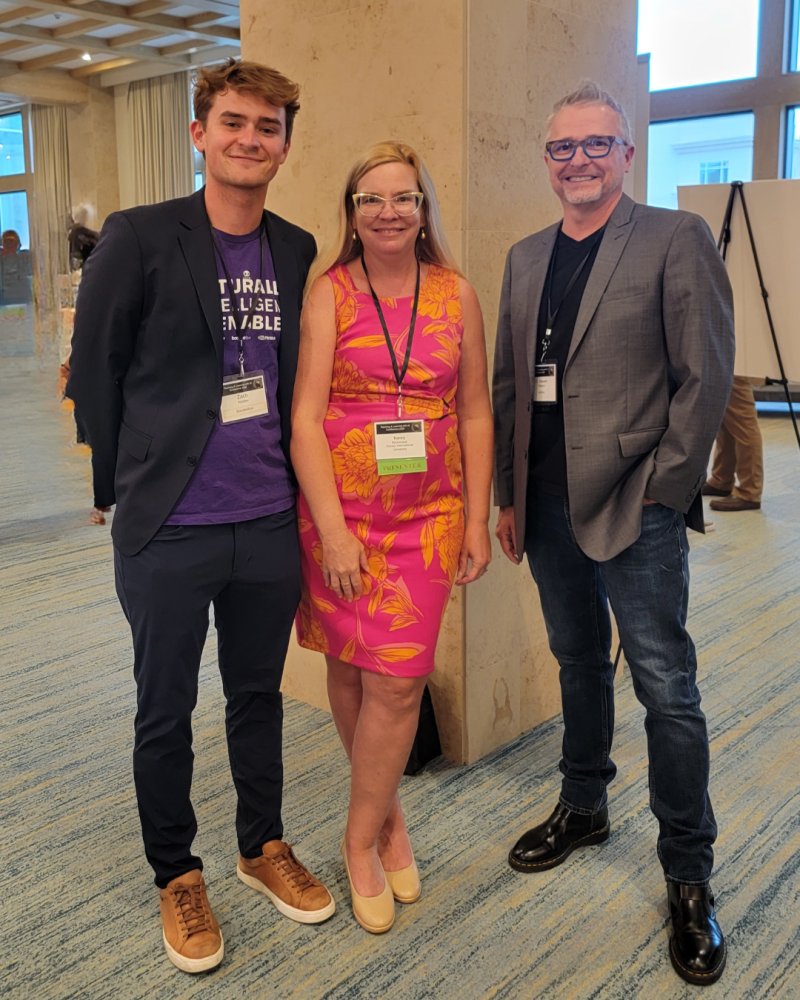
In that same hallway, I had the opportunity to reconnect with Zach Kinzler, who was showcasing Boodlebox, a collaborative AI platform for education, at the conference. That conversation led to a discussion of podcasts and to planning a future episode together, an idea that did not exist before this week and will outlast it.
That is what new friends look like in practice. Not a business card. A reason to keep talking.
But it is more than friendship. I have spent years studying how educators grow, and it always comes back to community. Not a network. A community of practice. People who keep showing up to trade what works, ask the hard questions, and build confidence with new tools together.
That is what was forming in those hallways, and the best part is what happens next. A business card goes in a drawer. A community of practice keeps going. We stay connected, trade what we are trying, and build real projects together long after everyone flies home.
By the last session, the room felt different from the way it had on day one. Strangers had become colleagues. Colleagues had become friends.
Bryan Alexander closed the conference. He is a futurist at Georgetown, and his book Academia Next: The Futures of Higher Education traces where all of this is going. He does not soften what is coming. He talks about an authentication crisis in how we assess students, about institutions that will have to remake themselves or fade. He sees the disruption more clearly than almost anyone. Then he ended three days of it by giving me a hug, and a group of us gathered for a photo.
The person who sees what is coming most clearly answered it with the most human thing there is.
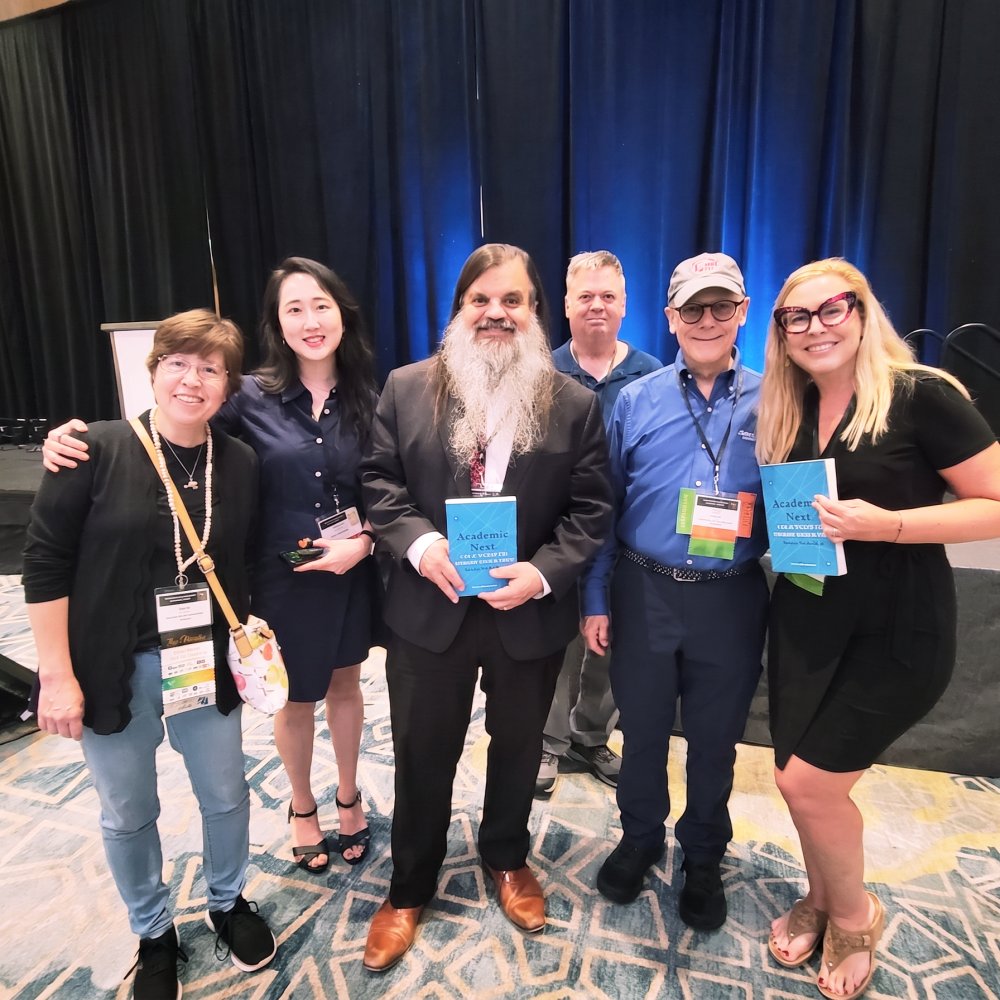
This is what connection looks like.
What I Am Carrying Home
Here is the one thing I know for certain. Our future is about to get very strange. If you have seen the movie Her, you have felt the edges of it.
So here is my answer to the question I came in with. If a machine can write the essay and answer the prompt, what is left for us to do?
Everything that matters most. We connect. We notice. We bring people into the room and keep them there. In a world that never logs off, a moment of real presence is the rarest thing we have to offer, and it is the one thing no machine can hand out at a registration table.
That is how we close the Presence Gap. Three days in that room narrowed it for everyone there, including me.
I wrote KEEP SHINING to name the things that keep us human while the world speeds up. This week, the conference was the book come to life. Four things I am taking with me:
Innovation is not keeping up with the tools. It is staying curious, asking the next question, and sharing what you find.
The way forward is interdisciplinary. The best ideas cross fields, so pull a designer, a librarian, and a professor up to the same table.
Do not stop at new friends. Build a community of practice, people who keep showing up to trade what works and learn together.
The future is about to get strange. Presence is how we stay human inside it.
I was given a duck and told to pass it on. I did, and then some. I made new friends, lots of them, and we traded books, ducks, and ideas. That, it turns out, is the whole answer.
I left Orlando more hopeful about teaching in this wild world of AI than I have felt in a long time. We will only succeed together.
So here is my invitation to you. Do not figure out AI alone. Make the time to gather. Trade an idea, a book, an invitation to the next event. Protect the conversations that shape what comes next. We do not have to wait to see what AI does to us. In rooms like that one, we get to decide it.
If you were in Orlando, thank you. You shaped my week. If you were not, I hope to see you in the room next year.
You were never meant to shine alone.
Keep shining together.
Dr. Nancy Richmond is a professor at Florida International University's College of Business, where she co-chairs the AI Teaching Forum, and the author of KEEP SHINING: Rediscovering Purpose and Connection in a Digital World. She helps leaders connect and innovate with purpose in a digital world.
